
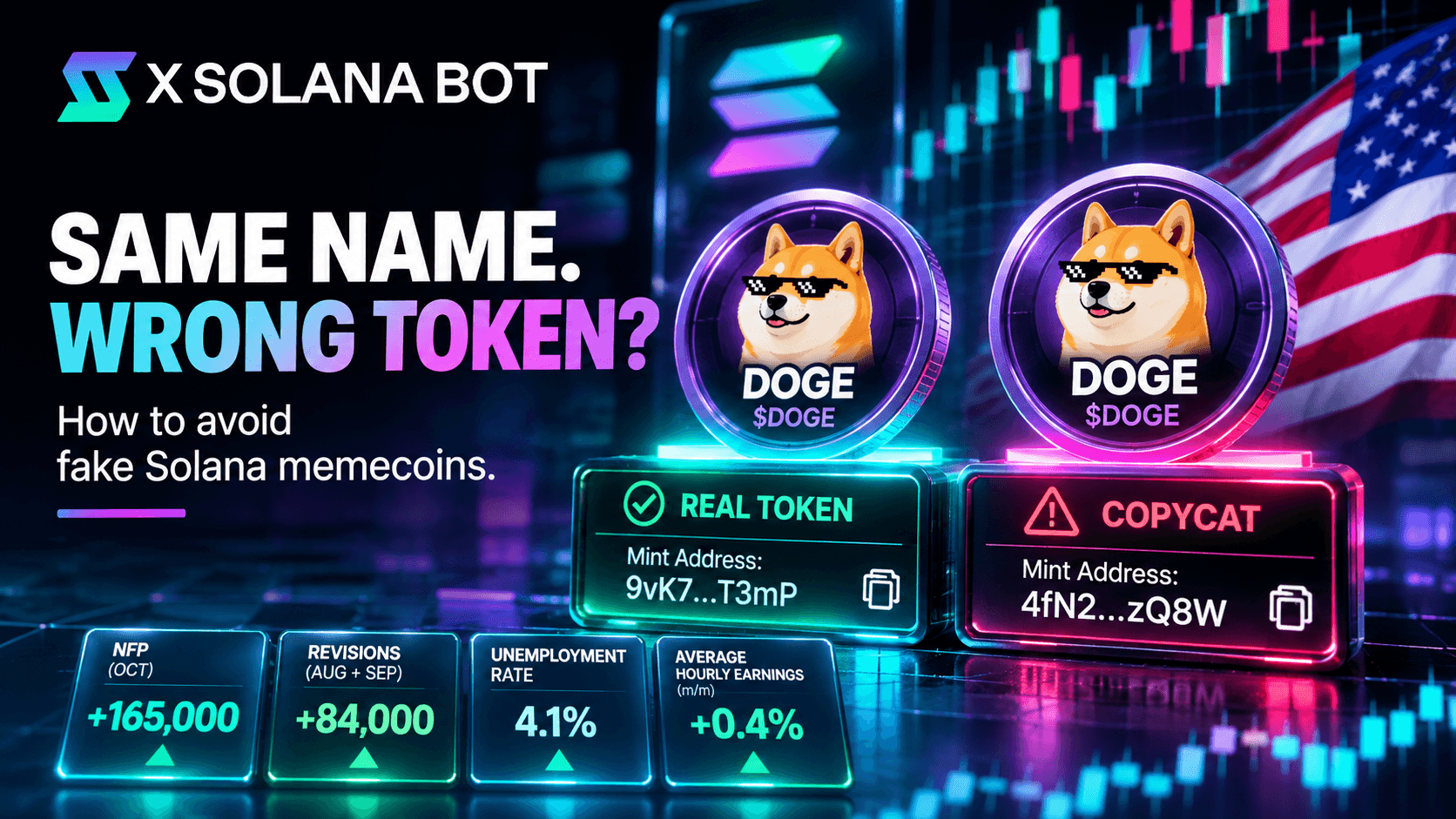
Two Solana memecoins can share the same name, ticker symbol and logo while representing completely different blockchain assets. For traders searching for newly launched tokens, this creates a risk that is easy to overlook: buying a convincing imitation instead of the token they intended to purchase. Understanding how Solana token identity works, how metadata can be copied and what verification actually confirms is an essential part of researching memecoins before trading.
Why fake Solana memecoins can look identical to real projects
The Solana ecosystem allows developers to create new tokens without requiring a unique name or ticker symbol across the entire blockchain. This flexibility supports permissionless innovation, but it also creates an opportunity for imitation.
If a memecoin becomes popular, another creator can launch a separate token using the same or a similar name. The imitation may also display the original project's logo, a familiar ticker and social links that appear connected to the established community.
From the perspective of an inexperienced trader, the two assets can appear almost identical.
A search for a trending ticker may return several results. Some may be legitimate projects with coincidentally similar names. Others may be copycat tokens designed to benefit from confusion around an existing narrative.
The important distinction is that a token's visual identity is not the same as its blockchain identity.
Names, symbols and images are descriptive information. They help people recognize assets, but they do not function as universally unique identifiers.
This is why a trader should never treat a matching logo or ticker as sufficient confirmation that they have found the intended token.
The mint address is the token's actual blockchain identifier
Every fungible token on Solana is associated with a mint account. Its address is the primary identifier used to distinguish that token from other assets on the network.
In many trading interfaces, this address is labelled as the token's contract address, although the underlying Solana architecture differs from the contract model commonly associated with Ethereum.
Two separate Solana tokens can use the same ticker, but they cannot share the same mint account address.
That distinction makes the mint address much more reliable for identifying a specific asset.
Imagine a trending memecoin called MOONCAT. A trader sees a post featuring the project's logo and searches for MOONCAT in a trading application. Several tokens appear under the same name.
The results may look similar, but each token can have a different mint address, supply structure, market history and trading pool.
One may correspond to the project the trader was looking for. The others are separate blockchain assets regardless of how closely they imitate its branding.
Before evaluating the investment, the trader must first establish which mint address represents the intended token.
This is not a prediction about price performance. It is a basic identity check.
Why searching by ticker alone creates unnecessary risk
Ticker symbols are useful because they are short and easy to remember. They make markets more accessible and help traders recognize commonly discussed assets.
However, their convenience creates ambiguity.
A ticker is not guaranteed to be unique on Solana. The same symbol can appear across unrelated tokens created by different developers.
This becomes particularly problematic when a token goes viral. A project may suddenly receive significant social media attention, encouraging traders to search for it as quickly as possible.
Copycat assets can exploit that urgency by presenting familiar branding and appearing among search results.
A trader who selects a token based only on its ticker may never realize that a different asset was purchased.
This risk can also affect automated strategies. A trading bot can execute the transaction requested by its user, but it cannot determine the user's original intention from an ambiguous ticker alone.
An accurate contract address removes that particular ambiguity by identifying the specific asset the trader wants to interact with.
How Solana token metadata works
The visual information displayed by wallets and token explorers generally comes from token metadata.
For conventional SPL tokens, the Metaplex Token Metadata program can associate a metadata account with a particular mint. That metadata may include the token's name, symbol and a URI pointing toward additional information such as its image and description.
The image itself is often referenced through data stored outside the blockchain rather than being embedded directly inside the token's mint account.
This architecture is useful because it allows applications to display recognizable information without storing large image files directly on-chain.
However, it also means that visual presentation should not be confused with independent proof of project identity.
A token creator can choose familiar names and images when configuring metadata. Depending on the token setup and relevant authority permissions, certain metadata fields can also be updated later.
This creates a clear distinction between the permanent mint identity and the descriptive information associated with it.
For traders, the practical implication is important.
A copied logo may be visually convincing, but it does not make a separate mint the same asset as the original project.
Can a Solana token change its name or logo after launch?
Some Solana tokens support mutable metadata.
When the relevant metadata account is configured as mutable and the required update authority remains available, an authorized party may change fields such as the token's name, symbol or metadata URI.
A URI update can alter which image or description is displayed by applications that resolve the new metadata.
These capabilities have legitimate purposes. A project may update its branding, correct incorrect information or migrate its metadata to a more reliable hosting provider.
But mutable metadata also creates a potential source of confusion.
A token's public-facing appearance can change without creating a new mint address. Someone monitoring only the name or logo may therefore fail to recognize that the asset's descriptive information has been modified.
This is another reason to treat the mint address as the central reference point.
The mint address identifies the asset. Metadata describes how that asset is presented.
An immutable metadata configuration can reduce certain types of future changes, but it does not independently establish that a token is financially sound, honestly managed or free from other risks.
What does a verified Solana token actually mean?
Verification systems help traders distinguish recognized tokens from impersonators.
Solana Explorer incorporates verification information from independent providers, including services within the Solana trading and analytics ecosystem.
One widely used example is Jupiter's verified token system, which can help identify the recognized token associated with a particular project name and mint address.
Verification is valuable because it adds an identity signal that goes beyond a manually selected name or logo.
However, the meaning of verification has limits.
A verified token is not automatically a safe investment.
Verification can help establish that an asset is the recognized token for a particular project. It does not guarantee that its price will rise, its liquidity will remain available or its developers will make responsible decisions.
A token may be correctly identified and still have significant speculative, technical or liquidity risks.
The absence of verification should also be interpreted carefully. A newly launched legitimate token may not yet have completed a review process or accumulated the history required by a particular verification provider.
A missing badge therefore does not automatically prove that the project is fraudulent.
Verification should be used as an important identity signal, not as a replacement for broader analysis.
Where should traders obtain the correct mint address?
The most important part of the verification process is determining which mint address the intended project actually recognizes.
Official project channels can help establish this information. A project may publish its mint address on its website, in an announcement from an established social media account or through a recognized ecosystem listing.
However, the source itself also needs to be evaluated.
Impersonators can create fake social media profiles, misleading websites and copied announcements. A link that appears official at first glance may lead to a different token or a malicious application.
For this reason, traders should compare information across trusted sources rather than relying on one isolated screenshot or an unfamiliar account posting a contract address.
Once a mint address has been identified, the full address should be compared in a reliable Solana explorer or token-information service.
This helps connect the project's claimed identity with the actual blockchain asset.
It is especially important to avoid relying only on shortened addresses. Two addresses may share visually similar beginning or ending characters while differing elsewhere.
The complete identifier matters.
How to verify a Solana token before buying
A reliable verification process should begin before a trade is submitted.
First, establish which project you intend to trade and identify its claimed official mint address through sources you have independently assessed.
Next, open the token's mint account in a blockchain explorer or a reputable Solana token-information service.
Compare the entire address rather than trusting the displayed name, ticker or image.
The explorer should show information associated with that particular mint. Depending on the service, this may include supply information, token-program details, metadata and relevant authorities.
Then compare the explorer result with the asset presented in your trading application.
The address displayed in the trading interface should match the intended mint exactly.
If multiple similarly named tokens appear, do not choose based on search ranking alone. The most prominent result is not necessarily the asset you intended to find.
Finally, examine additional risk indicators before deciding whether to trade.
Identity verification answers the question of which token you are viewing. It does not answer every question about the quality of that token's market.
Why a matching contract address is more important than a matching logo
A logo can be copied easily.
A ticker can be reused.
A token name can be duplicated.
A social media image can be taken from another account.
But a different token mint represents a different asset.
This makes address verification one of the most straightforward ways to reduce the risk of accidentally purchasing an imitation.
It also provides a stable reference for further analysis.
Once the correct mint has been established, traders can investigate the associated holder distribution, liquidity, trading activity, authorities and market history.
Without that identity check, the analysis may be performed on the wrong asset.
Even sophisticated market indicators become much less useful if they describe a token the trader never intended to purchase.
This is an important principle in Solana memecoin analysis: accurate identification must come before evaluating market opportunity.
The difference between a mint address and a liquidity pool address
Solana trading involves several types of blockchain accounts, and confusing their roles can introduce additional mistakes.
A token's mint address identifies the asset itself.
A liquidity pool address identifies a particular pool or market structure through which assets can be exchanged.
A token account is used to hold balances of a specific token for a particular owner or authority arrangement.
These addresses are related to the trading process, but they are not interchangeable.
A token may also trade through several different liquidity pools, each with its own reserves, fee structure and execution conditions.
The existence of multiple pools does not mean the token has multiple mint identities.
When verifying token identity, the relevant comparison is the token's mint address rather than an arbitrary pool or wallet address.
Understanding this distinction helps prevent confusion when moving between blockchain explorers, market scanners and trading applications.
Does correct token verification eliminate rug-pull risk?
No.
Identity verification and investment-risk analysis are separate processes.
A token may have the correct mint address and still suffer from concentrated ownership, weak liquidity, excessive token supply, adverse administrative permissions or poor market conditions.
A project may also experience a legitimate decline in market interest without any malicious activity taking place.
This means that establishing token authenticity is only the first analytical step.
Once the intended asset has been identified, traders still need to evaluate its market structure and technical characteristics.
Relevant considerations may include whether mint or freeze authority remains active, how supply is distributed, whether liquidity is accessible and whether token activity is concentrated among a small number of participants.
Token-2022 assets may introduce additional features requiring further evaluation, including transfer restrictions and specialized authority configurations.
These considerations are important, but they address different questions from identity verification.
The correct token is not necessarily a good token.
It is simply the intended token.
Why new memecoin launches make identity checks more important
Newly launched Solana memecoins often develop quickly.
A token may attract significant attention immediately after creation, particularly when its narrative connects to a trending topic, an established community or a viral social media event.
During these early stages, available information can be incomplete.
A token may not yet appear consistently across every major data provider. Its verification status may be pending, and different interfaces may display information at different times.
This environment can make traders more dependent on manually shared contract addresses and social media announcements.
The pressure to act quickly can also encourage users to skip basic verification steps.
However, a rapidly moving market does not make identity checks less important.
It makes mistakes more expensive.
A trader who enters the wrong token may gain exposure to an entirely different market, regardless of how accurately the original project's price movement was anticipated.
Using XSolanaBot with a verified mint address
XSolanaBot provides a workflow for discovering and trading Solana tokens.
According to its published feature description, users can search for tokens by name or contract address, purchase them using SOL and configure automatic selling conditions such as Take Profit and Stop Loss.
The platform also provides a dynamically updated list of newly launched memecoins.
These functions make it convenient to locate assets and manage positions, but they do not remove the importance of selecting the correct token.
When a trader already knows the intended mint address, searching by that specific identifier is a more precise approach than relying on a commonly reused ticker.
The process should begin with confirming that the mint corresponds to the project the trader intends to buy.
After that, the trader can evaluate the available market information and decide whether the position fits their own strategy and risk tolerance.
Automated selling conditions can help manage exits, but they do not protect against choosing the wrong asset in the first place.
Better token selection begins with better identification.
What should you do if you bought the wrong Solana token?
Discovering that a purchased token is not the intended asset can be concerning, particularly if the purchase was made during a period of rapid market activity.
The first step is to establish exactly which mint was purchased and review the transaction using a reliable blockchain explorer.
The fact that a token is an imitation does not automatically mean that the wallet itself has been compromised.
However, additional caution is appropriate if the purchase involved connecting to an unfamiliar website, signing unexpected transactions or interacting with a suspicious application.
Avoid following unsolicited recovery instructions or sending additional funds to anyone claiming they can reverse the transaction.
Blockchain transactions generally cannot be reversed simply because the purchaser selected the wrong asset.
Before taking further action, understand the token's current transferability, trading liquidity and the permissions granted during the interaction.
The appropriate response depends on the specific transaction and whether the risk concerns the asset itself or the security of the connected wallet.
How token discovery can become more trustworthy
Reliable Solana token discovery depends on several layers of information working together.
The mint address establishes which asset is being examined.
Metadata makes the asset recognizable.
Verification providers help determine whether the asset corresponds to a recognized project.
On-chain metrics explain the token's market behaviour.
Security and authority information reveal additional technical characteristics.
None of these layers replaces the others.
A trading interface becomes more useful when it allows users to understand both the identity of an asset and the market conditions surrounding it.
For memecoin traders, the objective should not be to collect the largest number of token alerts.
It should be to make sure the opportunities under consideration are correctly identified before financial decisions are made.
Final thoughts: verify the identity before analysing the opportunity
Solana's permissionless token ecosystem makes it easy to launch new assets and experiment with different communities and narratives.
That flexibility also means duplicate names, reused tickers and copied logos are possible.
For traders, visual familiarity is not enough.
The mint address is the key identifier connecting a token to its blockchain identity. Verification services can provide additional confidence about recognized projects, but they do not guarantee financial safety.
Before analysing market capitalization, liquidity or price momentum, establish that the token is the one you intended to find.
Then evaluate its market and technical risks separately.
Because finding a promising memecoin is one challenge. Making sure you found the right memecoin is another.